
U.S. Department of the Treasury
Improving Internal Service Delivery Through Agile Service Design
Treasury Operations manages a wide portfolio of internal administrative services — facilities, human resources coordination, logistics, and employee lifecycle support — for one of the federal government's most complex departmental organizations. In 2019, Deputy Assistant Secretary Michael Thomas volunteered to partner with MITRE's research program to demonstrate how private-sector service design practices could improve how Treasury Operations delivers those services to its internal customers.
The engagement began with a management off-site to establish a shared picture of current state, define the boundaries of the service environment, and identify a starting point for improvement work. What leadership did not yet have was a structured view of how operational processes, technology systems, and HR policy fit together — or where they failed to.
Over three months, an eight-member cross-functional team worked through an agile service design process, applying Agile PI Planning concepts adapted for a customer experience improvement context. The team down-selected to one specific, well-bounded service as the focus: employee relocation moves — a process that touched facilities, information technology, and HR simultaneously and had generated persistent friction for employees moving between offices.
The core output was a service blueprint mapping the full employee relocation process. Built from the front-stage / back-stage structure — what employees experience and request on one side, the supporting systems and processes operating behind the line of visibility on the other — the blueprint was developed iteratively through stakeholder interviews and data review, grounded in actual process behavior rather than assumed workflows.
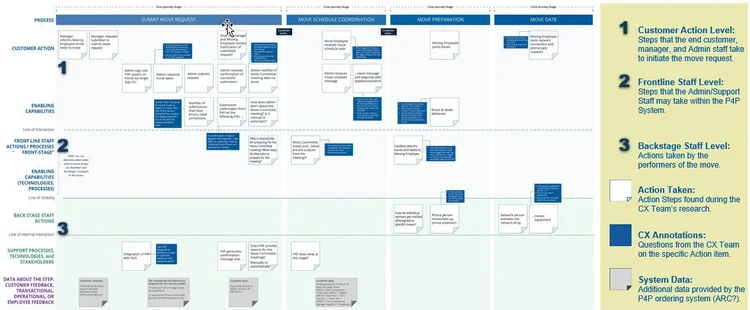
The front-stage / back-stage service blueprint of the Treasury Operations employee relocation process — mapping what employees experience against the supporting systems and processes operating behind the line of visibility.
Mapping the service as a system surfaced findings that had not been visible to leadership through conventional reporting. Two were structurally significant.
The relocation process depended on a provisioning application that Information Technology had designed in collaboration with HR — but without the participation of the Operations staff responsible for running the actual relocation process. The application reflected what IT and HR understood the process to be, which did not fully match how the process actually operated.
The second finding was more specific: HR carried an expectation that employees would update their own location information in the system after a move. This assumption had never been surfaced or communicated. Almost no employees were aware of it, and it had not been addressed during the application's design. The gap between the assumed workflow and the actual one was a primary driver of the errors and delays that had made the relocation process a persistent pain point.
Within three months, a part-time team had mapped a service environment that leadership had not previously been able to see as a complete system. The blueprint gave Treasury Operations a concrete, evidence-grounded basis for prioritizing the specific policy, process, and system changes needed to resolve errors and reduce delays.
Equally important was what the team gained in the process. Treasury Operations staff left the engagement with the analytical skills — data-grounded problem framing, front-stage / back-stage mapping, structured hypothesis testing — and the tools to continue improving their service environment independently.