
A Working Methodology
The models and approaches described here have been developed and refined through practice across multiple federal agencies, and informed by current thinking about government reform. They are working tools — grounded in evidence, continuing to evolve, and offered here as a starting point for dialogue rather than a finished prescription.
The Public Value Aperture
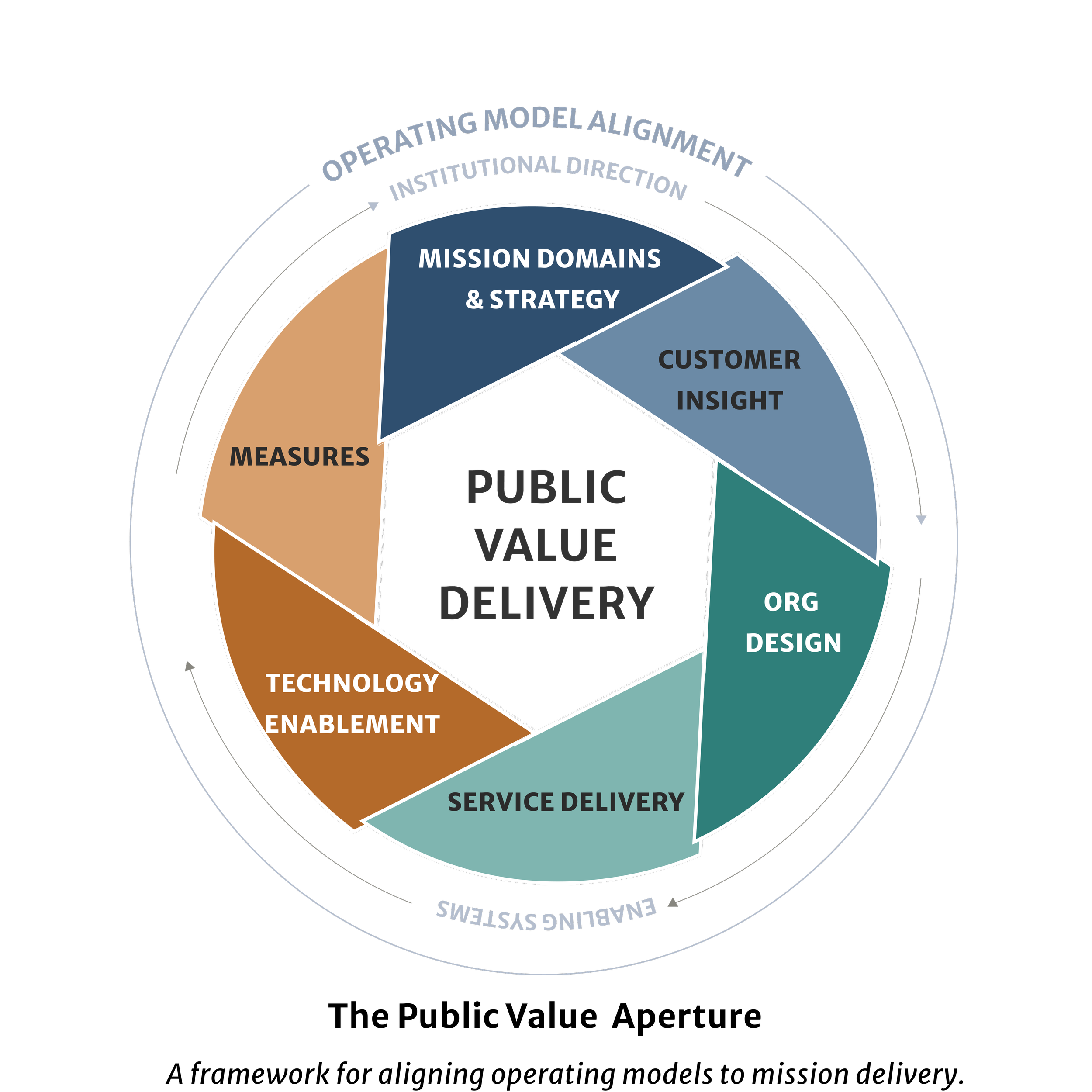
An operating model describes how an organization works together to deliver public value. Every enterprise operating model has six interdependent elements that work as an integrated system. Like the blades of a camera aperture, all six must align to produce a clear focus on mission. No single blade delivers the image.
The Public Value Aperture is the framework for designing that alignment — and for assessing where the gaps are.
Explore the framework →Five Diagnostic Questions
The Federal Mission Alignment model organizes operating model engagement around five diagnostic questions that must be answered before structural or technical decisions are made. Each question builds on the one before it.
- WHY What is the statutory mission, and what public value does the organization uniquely exist to deliver?
- WHAT What are the mission and business domains, their portfolios, and the value streams that deliver them?
- WHO Who are the customers, stakeholders, and oversight bodies — and what does each require?
- HOW How should the organization, teams, and technical architecture be designed to align to domain and stream boundaries?
- HOW WELL What measures make mission outcomes — not activity — visible to leadership and the people served?
Two Scopes of Work
Operating model work looks different depending on where genuine decision authority sits and what scope of change is possible. Two scopes of engagement have proven useful — not as a rigid program, but as a starting point for scoping the work together.
These descriptions are starting points. The right entry point, sequencing, and scope depend on the specific context — and that conversation is where the work begins.
Visual Thinking Toolkit
Visual thinking tools are central to this work — not as deliverables, but as the artifacts that make complex systems legible, generate shared understanding, and make analysis actionable. The following tools are part of a repertoire built through practice across multiple engagements.
This methodology is designed to be tested, challenged, and improved through field engagement. If you are working on operating model design, government reform, or the structural conditions that make transformation durable — and you see something here worth building on — let's talk.
Start a conversation →