
Customer Roles Framework
A structured map of who interacts with a mission organization — organized by the roles customers and stakeholders play in co-creating public value, and separated by a line of visibility between front-stage and back-stage operations.
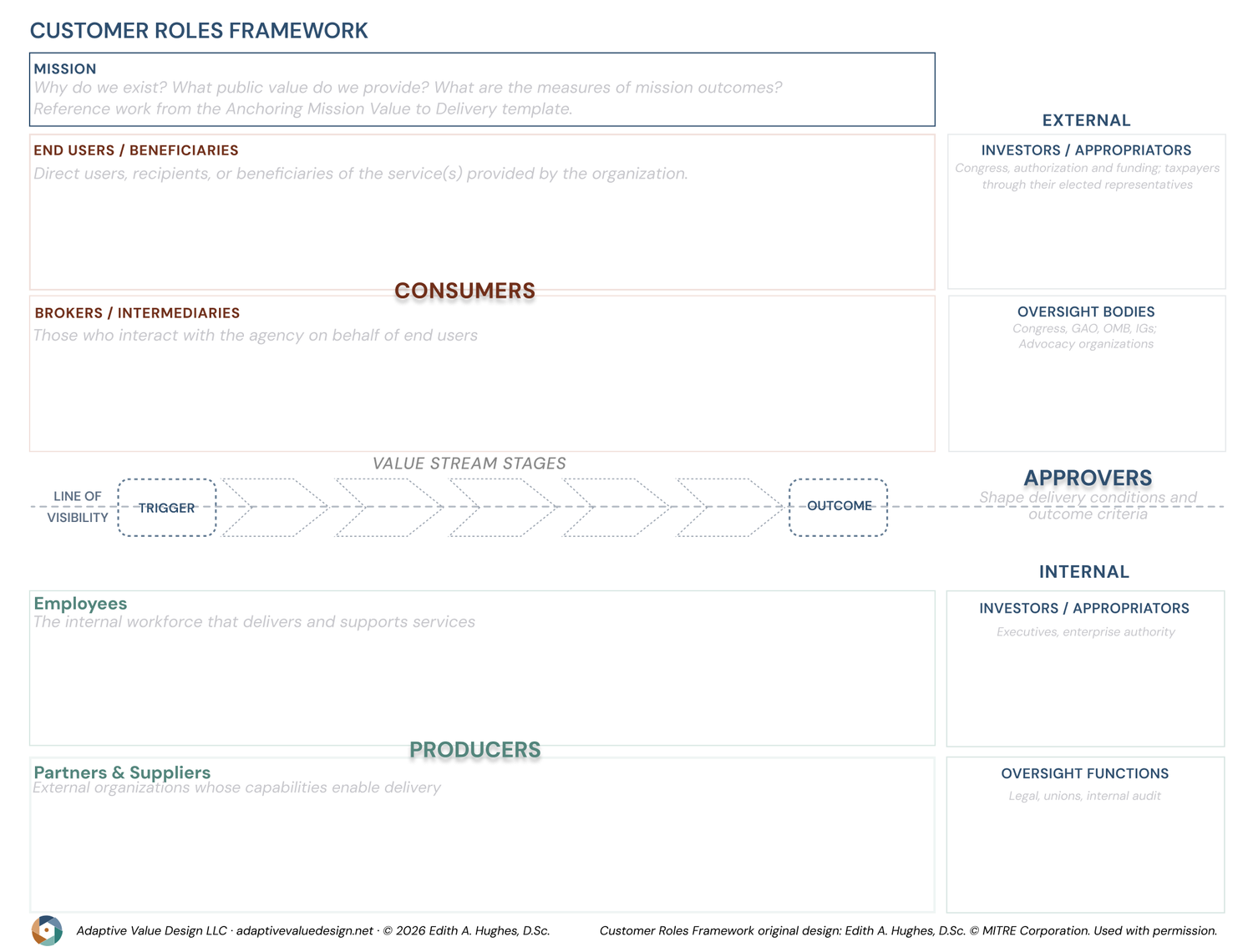
Customer Roles Framework · Adaptive Value Design LLC
The Customer Roles Framework organizes the full range of people and organizations that interact with a mission organization into three functional categories: Consumers, Producers, and Approvers. A Line of Visibility runs through the center of the framework, separating the customer-facing stages of the service journey from the internal operations that enable delivery.
A service is a series of interactions between customers and an organization to co-create value. The Customer Roles Framework identifies who participates in that co-creation — and the roles they play — in the context of a public sector organization.
- Names the people a mission serves and the people who make delivery possible as distinct roles with distinct needs
- Makes the Line of Visibility explicit, so teams can see which parts of their work are customer-facing and which enable delivery from behind the scenes
- Surfaces the full stakeholder landscape at enterprise level — including Approvers whose requirements shape the conditions of delivery
- Reveals when the same participant plays more than one role — a pattern that affects both service design and measurement
- Start with the mission — Record the organization's public value statement and statutory purpose at the top of the canvas. Reference the completed Anchor Mission to Public Value canvas if available.
- Identify Consumers — List the end users and beneficiaries who receive or use each core service. Then identify any intermediaries who interact with the organization on their behalf.
- Identify Producers — List the internal workforce and external partners whose capabilities enable delivery. Include employees, contractors, data suppliers, and community partners.
- Identify Approvers — List the oversight bodies, legislative authorities, and regulatory actors who shape the conditions under which the organization delivers.
- Map the Line of Visibility — Identify the stages of the value stream where Consumers interact directly with the organization. These are front-stage. Everything behind that line enables front-stage delivery.
- Check for dual roles — Identify any participants who appear in more than one role. Note the implications for service design and measurement.
- Complete the WHO row of the Anchor Mission to Public Value canvas before beginning this framework — the enterprise-level customer view in that canvas is the starting point
- Different core activities often have different customer populations — map by activity if the organization performs more than one distinct mission function
- Approvers are not peripheral — their requirements define the statutory and regulatory envelope within which delivery occurs
- The Line of Visibility is a diagnostic tool: work that crosses the line without customer awareness is a design decision worth examining
Some participants appear in more than one role simultaneously. A survey respondent provides the data the mission depends on (Producer) and experiences the burden of the collection process (Consumer). A Congressional committee appropriates funding (Approver) and uses the resulting data to inform legislation (Consumer). Naming the dual role makes both sets of needs visible — and supports service design that serves each role on its own terms.
- Provides a complete picture of who the organization is accountable to and for — the foundation for defining meaningful performance measures
- Grounds service design in the full population of stakeholders, with distinct attention to the needs of each role
- Supports team design decisions by making visible which teams own front-stage delivery and which own back-stage enabling capabilities
- Creates a shared vocabulary for discussing customers and stakeholders across leadership, service design, and technology teams