
Anchor Mission to Public Value
A structured canvas for translating statutory mission into the core activities, customer roles, value streams, and measures that confirm an organization is delivering on its public purpose.
Anchor Mission to Public Value · Adaptive Value Design LLC
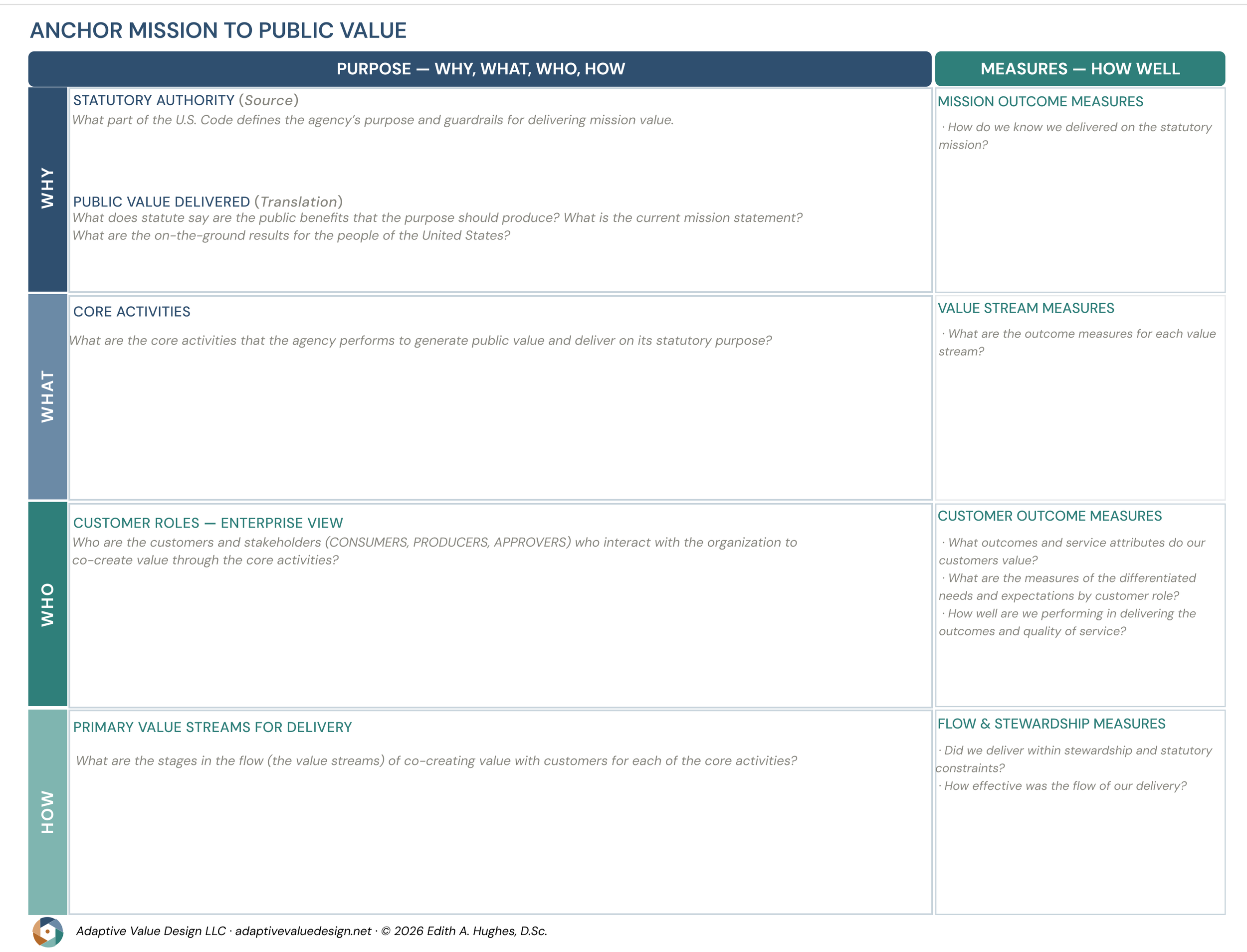
The Anchor Mission to Public Value canvas structures the five questions at the center of federal operating model design: WHY the organization exists, WHAT it does, WHO it serves, HOW it delivers, and HOW WELL it performs. Each question has a corresponding row on the left side of the canvas and a column of measures on the right.
The canvas draws on statutory authority as its starting point. Every completed row traces back to what Congress has authorized the organization to deliver — not to strategic intent or organizational preference.
- Grounds operating model decisions in statutory purpose rather than inherited structure
- Makes the connection between mission, customer roles, and performance measures explicit and visible
- Creates a shared reference point that leadership teams can use to align investment, design, and accountability decisions
- Works at enterprise level and scales to individual programs, domains, or teams
- WHY — Read the statute and current mission statement. Identify what Congress has authorized this organization to deliver.
- WHAT — Identify the core activities the organization performs to fulfill its statutory purpose. State the need that triggers each activity and the outcome it produces.
- WHO — For each core activity, map who the organization serves: Consumers, Producers, and Approvers. Use the Customer Roles Framework as a companion tool.
- HOW — Map the core stages of the service journey from the Consumer's perspective. Identify what the organization provides at each stage.
- HOW WELL — Define measures at three levels: mission outcomes, core activity outcomes, and service journey attributes. The right column of the canvas holds the measures for each row.
- Work through the questions in sequence — each row builds on the prior one, and completing each step often surfaces something that refines what came before
- The canvas works for a single analyst preparing a briefing and for a leadership team working through the questions together
- Treat the first pass as a working hypothesis — the value of the canvas comes from the conversation it generates, not from filling it in
- A completed canvas at enterprise level becomes the reference point for domain-level and team-level work downstream
- Produces an explicit, shared articulation of what an organization does, for whom, and toward what outcome
- Generates the inputs that operating model design requires: mission value, customer roles, value streams, and measures
- Surfaces gaps in current performance measurement — particularly where activity counts can be supplemented with outcome measures
- Provides a durable reference document that anchors technology investment decisions, organizational design choices, and budget justifications