
The Public Value Aperture
An operating model describes how an organization works together to deliver value. It has multiple elements that leaders design and implement so that those elements integrate effectively and complement each other in execution. The Public Value Aperture is a framework for operating model design that supports the intentional alignment of six interdependent elements: Mission Domains and Strategy, Customer Insight, Organization Design, Service Delivery, Technology Enablement, and Measures. Together, these elements enable consistent delivery of public value.
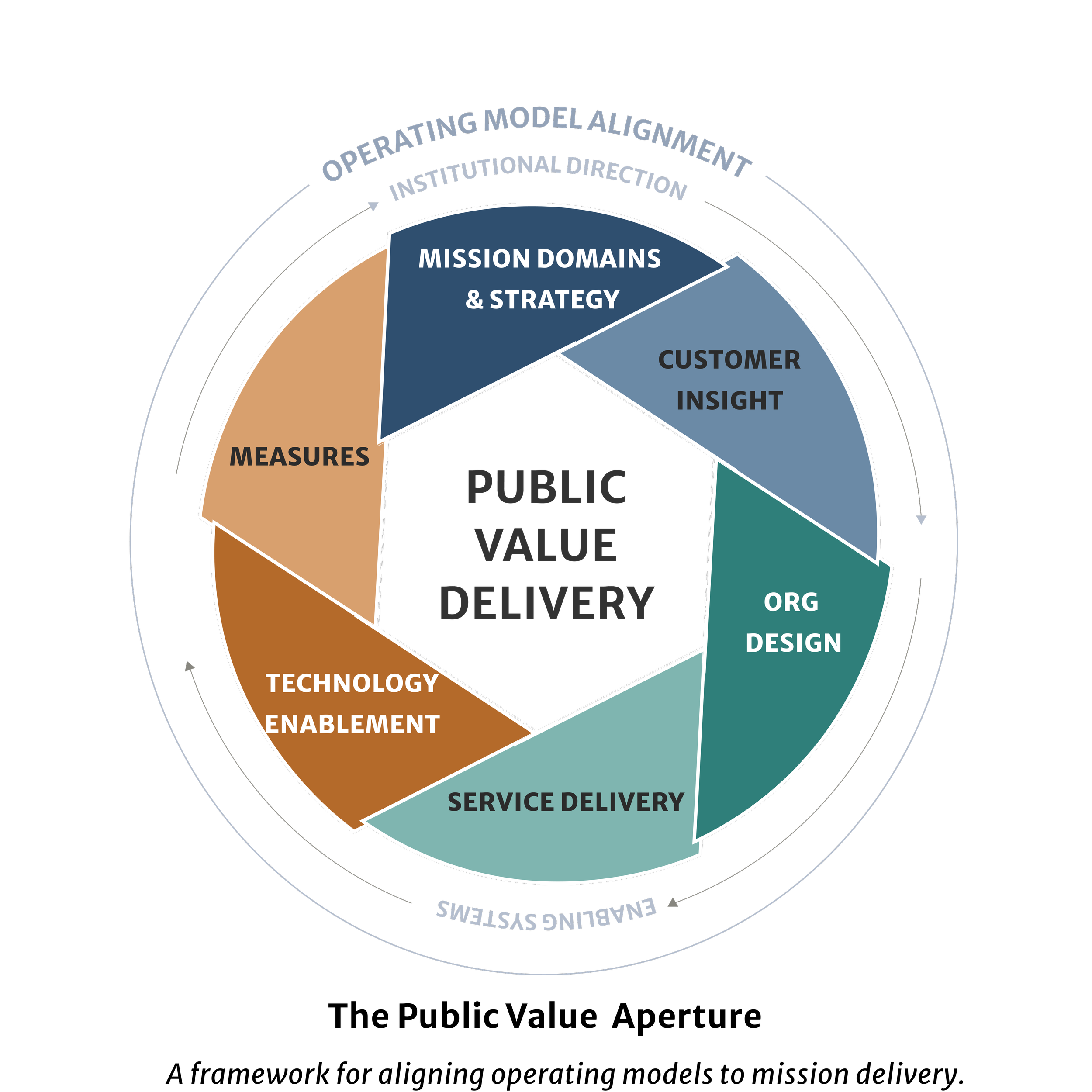
The Public Value Aperture — six interdependent elements, aligned to a shared definition of public value
The Aperture
At the center of the aperture is a definition of public value — why the organization exists, what they deliver, and for whom. Statute authorizes an organization's purpose and establishes the guardrails within which it operates. But translating that statutory authorization into a working definition of public value is a leadership act. It requires executive teams to reach shared clarity on what the organization is genuinely trying to produce for the people it serves.
Value, in this context, is not the same as cost and efficiency. In the public sector, customers and stakeholders perceive value through many attributes, such as achieving a specific goal or outcome, and the ease, simplicity, security, timeliness, and transparency, cost, and efficiency of that process. A leadership team needs to establish a shared definition of public value, grounded in an understanding of why the organization exists, who they serve, and what those customers need and value. That shared definition is the foundation for designing and aligning the operating model elements.
The three Institutional Direction elements — Mission Domains and Strategy, Customer Insight, and Measures — establish the strategy, structure, and data-driven insights that provide the path forward. The three Enabling Systems elements — Organization Design, Service Delivery, and Technology Enablement — provide the structure for executing the mission and value delivery. Ideally, all six elements work together, like the blades of a camera aperture, to produce a clear, sharp focus on public value.
The Challenge
Every organization has an operating model with these six elements. The challenge is that these elements are often developed independently instead of designed to work as an integrated system — not because leaders lack the intent to align them, but because they inherit bureaucratic complexity that has accumulated over many decades.
When decision authority, execution responsibility, and accountability for outcomes are dispersed across organizational structures, governance tends to become layered and coordination-heavy, execution becomes fragmented across boundaries, and mission performance becomes difficult to measure in any meaningful way. Leadership teams working to address these challenges often find themselves limited to treating the symptoms instead of the underlying structural conditions.
The Public Value Aperture offers leaders a framework to:
- Define public value
- Assess the six core elements in that context
- Examine how well they work together
- Design the alignment that makes sustained, responsive mission delivery possible
The Elements
Mission Domains and Strategy
The statutory authorization and core activities of the organization, organized into mission domains and value streams guided by strategic intent.
- Mission domains — the bounded areas of work through which an organization fulfills its purpose
- Value streams — the sequence of activities that delivers a specific outcome to a specific customer, from initial need to value received
- Investment and prioritization logic derived from the domain structure and strategic intent
- Leadership teams share a clear picture of the organization's mission domains and what belongs in each
- Investment conversations apply criteria from that shared picture rather than competing on organizational position or historical budget allocation
Customer Insight
A structured, data-grounded understanding of who the organization serves, in what roles, and what each role needs to receive value.
- Identification of customer roles — Consumers, Producers, and Approvers — and how each interacts with the organization
- Data and research on what each role needs and how they define the attributes of value they receive
- Differentiated understanding of how needs and value attributes vary by role and context
- Leadership teams have a shared, evidence-based picture of who the organization serves and what each customer role requires
- Customer understanding actively shapes how the organization sets priorities, designs services, and defines what success looks like
Measures
The performance indicators that make mission delivery visible, quantifiable, and actionable — tied to statutory purpose, customer-defined value, and value stream performance.
- Mission outcome indicators tied to statutory purpose
- Domain and value stream performance indicators
- Customer outcome measures reflecting what customers say they value
- Measures trace from statutory mission through domain outcomes to customer outcomes and value stream performance
- Leadership teams can see, at each level, whether the organization is delivering the public value it exists to produce — not just whether it is producing outputs
Organization Design
How teams are structured, how authority and accountability are assigned, and how performance management connects to mission results.
- Team structure organized around domains and value streams
- Decision authority and outcome accountability assigned at the team level
- Performance management systems that connect individual and team contributions to mission results
- Teams have the decision authority and accountability needed for autonomy in their domain
- Performance systems connect what people are accountable for producing to the outcomes the organization exists to deliver — not just to internal process compliance
Service Delivery
The end-to-end flow through which the organization co-creates value with its customers — including what customers experience directly and the backstage capabilities that make delivery possible.
- Enterprise and domain-level value stream maps
- Clear boundaries between what is shared across customer segments and what is differentiated by segment
- The line of visibility between customer-facing experience and backstage operations
- Leadership teams have a shared picture of value streams at enterprise and domain level
- Service design decisions follow from the domain structure rather than from historical channel or system boundaries
Technology Enablement
The architecture and innovation process through which technology supports the mission domain and value stream structure — giving teams the ability to deploy and evolve technology within their domain.
- System and architectural boundaries that align to domain boundaries
- Technology investment decisions informed by the domain structure and customer insight
- Team-level authority to make technology decisions within the domain they own
- Technology investment decisions reflect a shared picture of which value stream investments deliver the most mission impact
- System boundaries align with domain boundaries, reducing the coordination overhead that accumulates when technical systems cut across accountability lines
How the Elements Work Together
The Institutional Direction Elements
All three Institutional Direction elements point toward the same center, each contributing something the others depend on.
- Mission Domains and Strategy establishes the shared picture of what the organization does and why — the statutory authorization and core activities, organized by domain and value stream. This picture becomes the common reference point for decisions across the operating model.
- Customer Insight adds the data foundation: a grounded, differentiated understanding of who the organization serves, what each customer role needs, and how customers define the attributes of value they receive. Without this foundation, measures tend to reflect what is easy to count rather than what customers actually value.
- Measures close the loop — connecting statutory mission to domain outcomes to customer outcomes to value stream performance. When leadership teams design measures to capture what customers value, mission delivery becomes genuinely visible at every level of the organization.
The connection between Customer Insight and Measures is particularly consequential. Knowing how well the organization is performing on its mission requires leaders to have a solid foundation of understanding what customers need and value — and what data sources and methods inform quantifiable outcomes and actionable insights.
The Enabling Systems Elements
The domain and value stream structure established in Mission Domains and Strategy sets a structural logic that Organization Design, Service Delivery, and Technology Enablement all benefit from sharing.
- Organization Design translates domain structure into team structure — organizing teams around domains and value streams rather than inherited functional hierarchies, so each team can own the end-to-end delivery of value to a specific customer segment.
- Service Delivery follows that same domain structure, mapping value streams at enterprise and domain level with a clear picture of what is genuinely shared across customer segments and what is differentiated by segment.
- Technology Enablement mirrors those domain boundaries in the technical architecture, giving teams the ability to deploy and evolve technology within the domain they own without accumulating coordination overhead at system boundaries.
When all three Enabling Systems elements share a similar structural logic derived from well-defined domains, coordination overhead drops, accountability for outcomes becomes clearer, and technology investment decisions can be made on the basis of mission impact rather than organizational negotiation.
Why Core Elements Need Similar Designs
A well-aligned operating model is easier to achieve when the shape and boundaries of organization and team design and the technical architecture are similar to the shape and boundaries of the mission domains.
- Conway's Law observes that the structure of an organization and its communications determine the structure of its technology architecture. When leaders intentionally design team structures, interaction modes, decision-making authority, and outcome accountability to align with the logical structure of the mission domains, value tends to flow more cleanly.
- Decisions are made by the people who own the outcomes. Teams and their autonomy map to the domains and value streams they serve. Technical systems are managed within — rather than cutting across — accountability boundaries.
- When organizational authority, service delivery responsibility, and technical architecture reflect different structural logics, coordination becomes the primary work and sustained improvement becomes significantly harder.
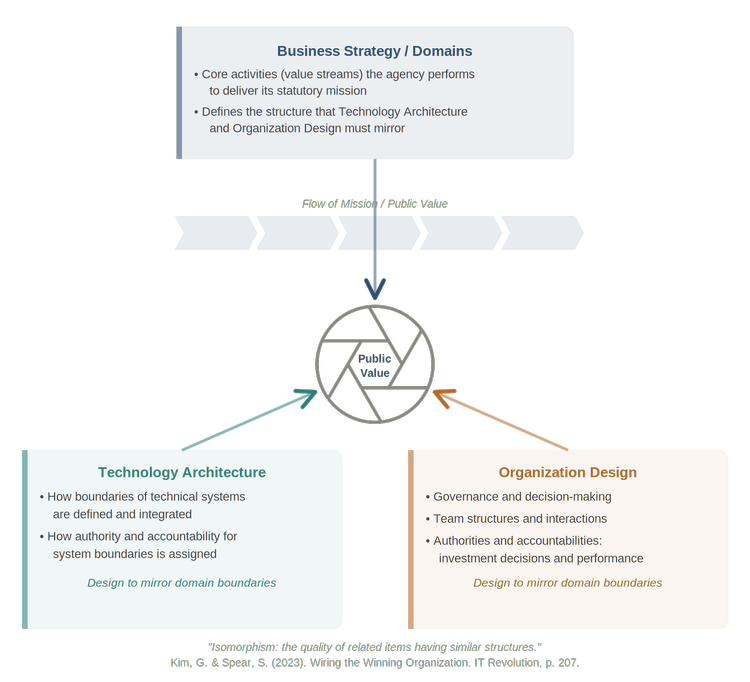
Figure 1. Mission domains, organization design, and technology architecture are most effective when designed to mirror each other's structures.
A well-aligned operating model applies this quality of isomorphism — designing closely related elements to have similar structures. Defining the flow of delivering public value provides the structural foundation of that design.
These examples are illustrative starting points. A fuller diagnostic treatment — including how to assess the current state of each element and identify where structural misalignment is creating the most friction — is in development as a companion tool.