
Framework · Adaptive Value Design LLC
The Customer Roles Framework
A Planning Tool for Federal Leaders
Edith A. Hughes, D.Sc. · Adaptive Value Design LLC · 2026
Service delivery is the co-creation of value between an organization and its customers. In federal government, identifying who those customers are requires a broader lens than most organizations apply. Most transformation efforts focus on end users — the individuals and organizations that receive the agency's services directly. That focus is correct and necessary. The Customer Roles Framework extends it to encompass everyone through whom the agency co-creates value: those who receive services, those who deliver them, and those whose authority shapes the conditions under which delivery is possible. Mapping all three categories is a prerequisite for defining value in terms that an operating model can be built around.
Consumers
Consumers are the people and organizations that receive the agency's services and the value those services deliver. The category contains two roles. End users are the beneficiaries: the individuals or entities for whom the service ultimately exists, whether or not they interact with the agency directly. A taxpayer is the end user of the IRS's filing and compliance services regardless of whether they file independently, through a tax preparer, or with software assistance. A patient enrolled in a federally administered health benefit is the end user regardless of whether a provider, a plan administrator, or a navigator submits claims on their behalf. Brokers and intermediaries are the organizations and individuals who interact with the agency on behalf of end users: tax preparers, benefits administrators, legal representatives, state agencies operating federal programs. Both roles co-create value with the agency, and both define what services must deliver — but they define it differently, and both definitions are design inputs.
Producers
Producers are the people and organizations through whom the agency delivers its services. Employees are the internal workforce: front-line staff who interact directly with consumers, analysts who process claims, technologists who build and operate delivery systems. Partners and suppliers are the external organizations whose capabilities the agency depends on: contractors who provide technical services, state agencies that administer federally funded programs, nonprofit organizations that conduct outreach on the agency's behalf. Producers co-create value by enabling delivery. An operating model that is not designed for the people who must operate it will not deliver consistently, regardless of how well it is designed for the people who receive it.
Approvers
Approvers are the parties whose authority shapes what the agency can do and how it is held accountable. The category operates across two dimensions simultaneously. External Approvers include Congress, which provides statutory authorization and appropriations; oversight bodies such as Inspectors General, GAO, and OMB, which set compliance requirements and assess performance; and civil society organizations with the standing to shape or influence agency decisions. Internal Approvers include senior executives with enterprise-wide investment authority and internal oversight functions — legal counsel, unions, internal audit — that govern how the organization operates. Approvers co-create value by establishing and sustaining the authorization and accountability conditions under which delivery is legitimate and durable.
Value Stream and Line of Visibility
The Value Stream represents the core stages of the flow of delivering value, based on the scope of the service delivery environment under consideration. For example, the value stream could be the core stages of mission activity to deliver enterprise value or a key component of enterprise value. Or the value stream could represent the stages of interaction for a specific product or service, such as issuing a passport, submitting a tax return, or gaining access to a national park.
The Line of Visibility separates the frontstage from the backstage of service delivery. Consumers and External Approvers are visible above the line: they experience the service directly or interact with the agency's outputs and decisions. Producers operate below the line, in the backstage functions that make delivery possible. Internal Approvers also influence internal operations through budget allocations and internal oversight. The line is a design tool that makes visible the interactions the agency must manage at the consumer-facing interface, and the internal operations that must align to support them.
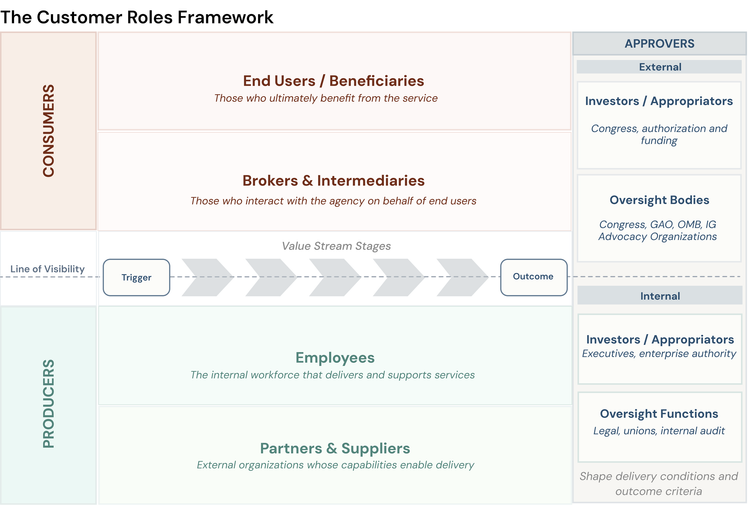
Figure A-1. The Customer Roles Framework. Original design: Edith A. Hughes, D.Sc. © MITRE Corporation. Used with permission.
Using the Framework
Mapping all three customer categories is a leadership team exercise, not an analytical one. The Census Bureau Data Dissemination Task Force's recognition that Congress was an Approver — a party whose early engagement was necessary to navigate the constraints and trade-offs of enterprise modernization — produced a fundamentally different posture toward oversight: proactive surfacing of constraints rather than reactive accountability management. That reframe did not emerge from a desk analysis. It emerged from a room full of senior leaders who had, for the first time, looked at their full customer landscape together. The shared map produced the shared insight.
© 2026 Adaptive Value Design LLC · Framework
In This Article
About This Framework
The Customer Roles Framework was originally developed through federal multi-agency practice and published by MITRE Corporation. It is a core component of the Public Value Aperture operating model framework.