
SEEING THE WHOLE SYSTEM
Designing operating models that connect mission intent to value delivery — and make complexity navigable.
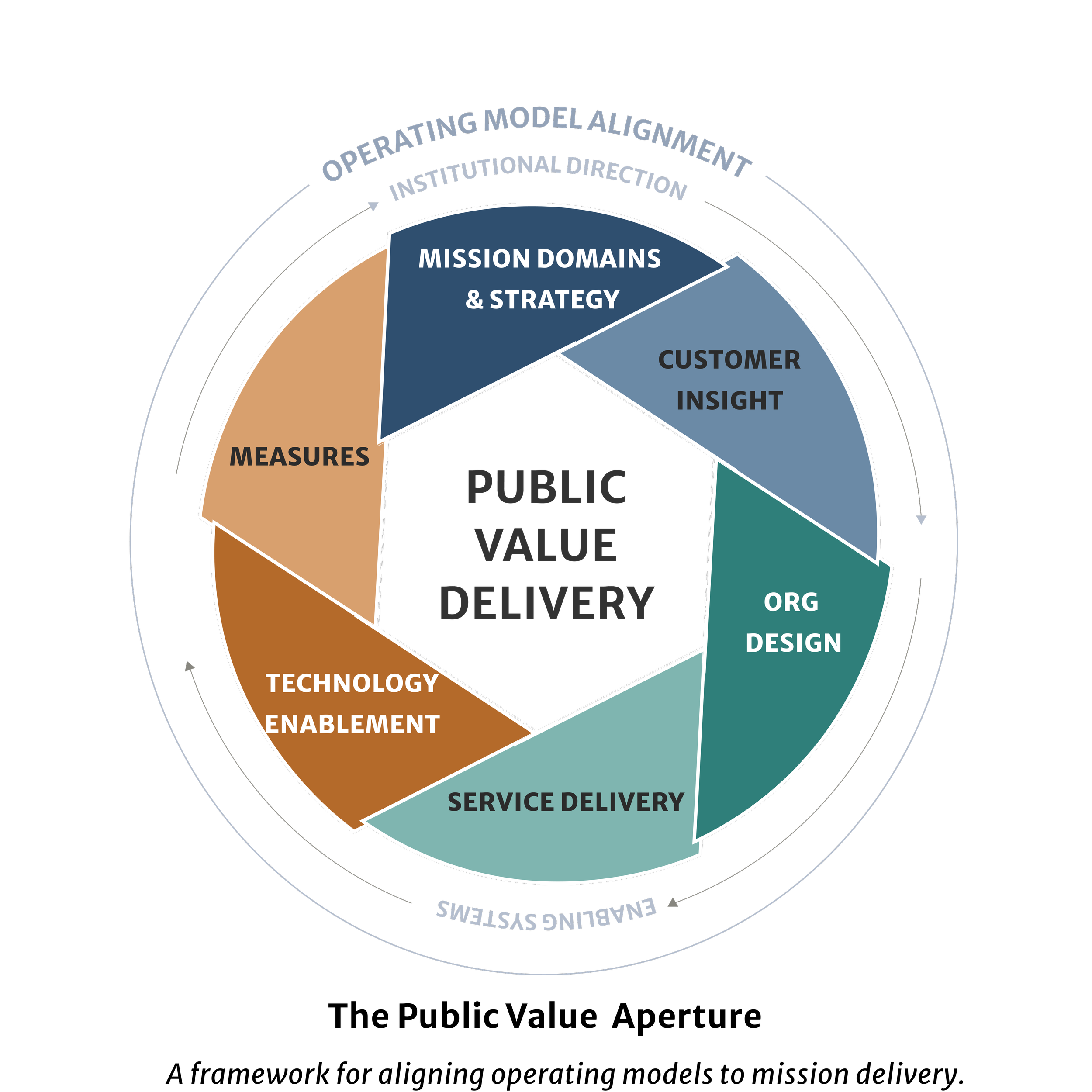
Adaptive Value Design works with leaders and teams at every level of complex, mission-driven organizations — building the structural foundation that aligns operating model to mission and public value, organization and team design that sustains the flow of value delivery, and the capacity to adapt as mission demands shift.
ABOUT
Practitioner | Researcher | Advisor
With more than 20 years of multi-agency federal engagement, I specialize in helping leadership teams align organization design, decision-making, and technical architecture to the mission they exist to deliver — through rigorous analysis and structured design work at every level of the organization.
My approach applies an integrated toolkit of methods such as operating model design, Team Topologies, and service design — making those frameworks actionable in the federal context, where the constraints are structural and the stakes are public.

AREAS OF EXPERTISE
- Translate mission into public value definition
- Define mission/business domains and their portfolios
- Define customers and stakeholders and their needs
- Design measures of mission outcomes, not activity
- Define domain boundaries and value streams
- Align team design and technical architecture to domain and stream boundaries
- Design organizations and teams for adaptive capacity and fast flow
- Assess operating models and surface structural gaps
- Facilitate and coach leadership and delivery teams
- Use visual thinking to foster innovation and analysis
- Build analytical capacity within and across teams for continuous improvement
In Practice
Selected Engagements
U.S. Census Bureau
Enterprise Scope - EXECUTIVE CO-DESIGN
Challenge: Sixteen executives from across a siloed bureau needed to align on a shared vision and roadmap for enterprise data dissemination — before any architecture decision could be made.
Approach: A five-week co-design process using scenario development, affinity analysis, and front-stage/back-stage mapping to build a sequenced roadmap across five capability areas.
Outcome: A unified leadership team, a shared enterprise vision, and an enduring capability — the Center for Enterprise Dissemination — that anchored the bureau's broader Transformation Initiative.
Read the case study →State Dept. / Bureau of Consular Affairs
Major PROGRAM SCOPE · ConsularOne
Challenge: Consolidation of 90+ disparate systems into a single platform without a shared big-picture view of the business functions and technical capabilities.
Approach: A purpose-built domain model showing the business flow connected to the technical capabilities, highlighting the points of integration and interdependencies.
Outcome: The program team could see, for the first time, the full program scope and the natural boundaries, sequencing, and integration points of the implementation.
U.S. Department of the Treasury
Team sCOPE · TREASURY OPERATIONS
Challenge: Demonstrating that agile and service design practices could solve a real operational problem — with a part-time team and a three-month clock.
Approach: Front-stage/back-stage scoping, stakeholder interviews, and a service blueprint that revealed HR policy and system issues driving errors and delays in employee relocations.
Outcome: Problem solved within the time constraint; team left with the analytical skills and tools to continue the work independently.
Read the case study →partnership
This work is designed to be piloted, tested, and built upon — in genuine partnership with organizations and initiatives serious about making mission-driven transformation real and durable. If you are working on operating model design, government reform, or the structural conditions that make lasting change possible, let's talk about what we could build together.